

Holistic wellness is defined as an integrative approach to health that treats the physical, mental, emotional, social, and spiritual dimensions of a person as a unified, interdependent system. Unlike conventional medicine, which typically targets a specific symptom or diagnosis, this approach asks a more demanding question: what does it mean to function at your best across every area of life? The concept sits at the heart of integrative medicine, a field that pairs lifestyle-based practices with conventional clinical care. Understanding what is holistic wellness matters more after 30, when the cumulative effects of stress, poor sleep, and sedentary habits begin to surface as chronic complaints rather than isolated incidents.
What is holistic wellness and why does it matter after 30?
Holistic wellness, as a formal concept, is grounded in the idea that no single dimension of health operates in isolation. The gut-brain axis is one of the clearest biological illustrations of this: the food you eat shapes your gut microbiome, which in turn influences mood, cognitive function, and stress response. Ignore your diet, and your mental clarity suffers. Ignore your stress levels, and your digestion pays the price.
After 30, the body’s margin for imbalance narrows. Recovery takes longer, stress accumulates faster, and lifestyle habits that once felt inconsequential begin to compound. The definition of holistic wellness is therefore not merely philosophical. It is a practical framework for managing the body as a system rather than a collection of separate parts.

The term “holistic” derives from the Greek holos, meaning whole. In healthcare, it has been formalised through models in integrative and preventive medicine that prioritise lifestyle pillars, including nutrition, sleep, movement, and cortisol regulation, as the foundation of long-term resilience. This is the vocabulary you will encounter from practitioners who work in this space, and it is worth knowing.
What are the key dimensions of holistic wellness and how do they interconnect?
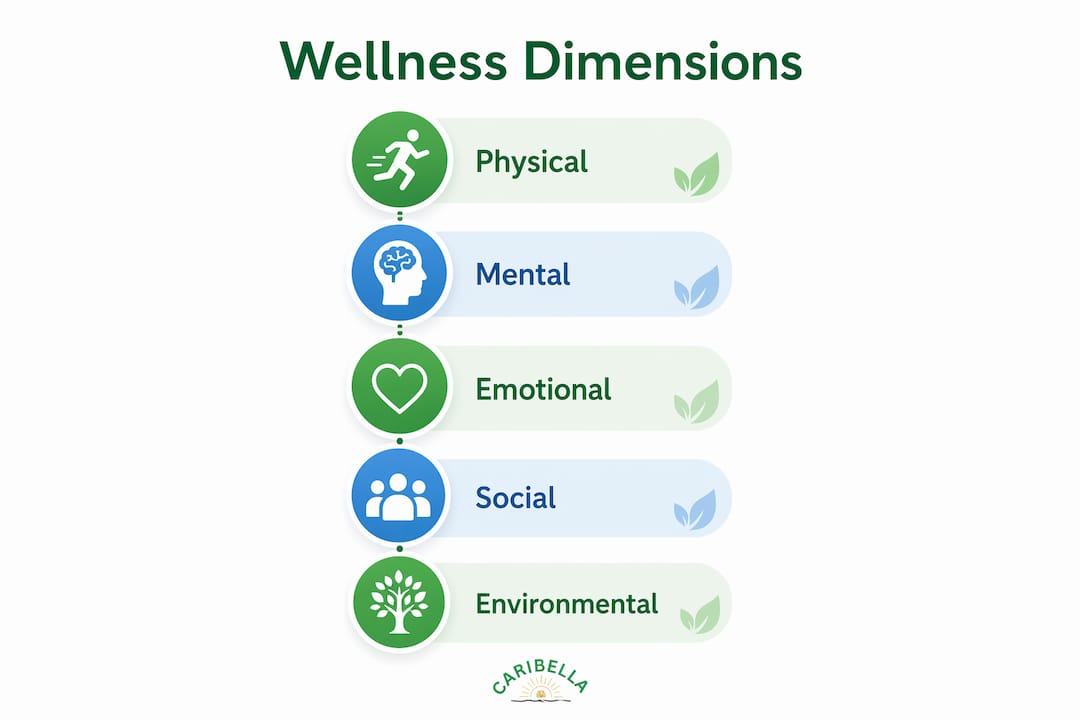
Most holistic wellness models identify between five and seven core dimensions that must be kept in balance for optimal health. The most widely recognised are physical, mental, emotional, social, and spiritual wellness. Some frameworks extend this to include environmental and financial wellness, acknowledging that your surroundings and economic security shape your health just as directly as exercise does.
Here is how each dimension functions and where it overlaps with the others:
- Physical wellness covers nutrition, sleep, movement, and the management of chronic conditions. It is the most visible dimension and often the first one people address.
- Mental wellness refers to cognitive function, focus, and the ability to process information and make decisions clearly. Chronic stress degrades mental wellness before most people notice.
- Emotional wellness is the capacity to recognise, process, and regulate feelings. Suppressed emotions frequently manifest as physical symptoms, including tension headaches, digestive issues, and fatigue.
- Social wellness reflects the quality of your relationships and sense of belonging. Isolation is now linked to measurable health decline, comparable in impact to smoking.
- Spiritual wellness does not require religious belief. It refers to a sense of meaning, purpose, and alignment between your values and your daily actions.
The interdependence of these dimensions is not abstract. A person under sustained work pressure experiences elevated cortisol, which disrupts sleep, impairs digestion, reduces emotional tolerance, and erodes social connection. Address only the sleep problem with a supplement and you have treated one symptom of a systemic imbalance.
| Dimension | What it covers | How imbalance shows up |
|---|---|---|
| Physical | Nutrition, sleep, movement | Fatigue, chronic pain, weight changes |
| Mental | Cognition, focus, decision-making | Brain fog, poor concentration |
| Emotional | Feeling regulation, self-awareness | Irritability, anxiety, psychosomatic symptoms |
| Social | Relationships, community | Loneliness, conflict, withdrawal |
| Spiritual | Purpose, values, meaning | Apathy, disconnection, lack of direction |
What does current science say about the benefits of holistic wellness?
The evidence base for holistic wellness practices has grown considerably. Yoga reduces cortisol more effectively than most other forms of exercise, and just five minutes of deep breathing practised three to five times daily produces measurable reductions in cortisol across a study group of 3,284 participants. That is a meaningful result from a practice that requires no equipment and no gym membership.
The gut-brain axis sits at the biological centre of why these practices work. Diet shapes the gut microbiome, which produces neurotransmitters including serotonin and dopamine. Mindfulness and stress regulation protect gut integrity by keeping cortisol within a healthy range. This means that a meditation practice is not just a mental health tool. It is also a digestive health intervention.
“Combining mindfulness and yoga with conventional care leads to long-term physiological resilience.” — Health.com on integrative medicine
Research also shows that mindfulness improves long-term resilience when integrated with lifestyle changes rather than practised in isolation. The key word is integration. A single yoga class does not recalibrate a system under chronic stress. Consistent, layered practice across multiple dimensions does.
Pro Tip: If you are new to breathwork, start with box breathing: inhale for four counts, hold for four, exhale for four, hold for four. Repeat for five minutes. This activates the parasympathetic nervous system and is one of the fastest evidence-backed methods for lowering acute stress.
The importance of holistic wellness also lies in what it prevents. Lifestyle pillars, including nutrition, sleep, movement, and stress regulation, build resilience against chronic conditions before they develop. This is a fundamentally different logic from waiting for symptoms to appear and then treating them.
How does holistic wellness differ from traditional health models?
Traditional medicine excels at acute care. A broken bone, a bacterial infection, a cardiac event: these are problems that conventional clinical practice handles with precision and speed. The distinction between holistic wellness and traditional health is not that one is better than the other. It is that they address different questions.
Traditional symptom-focused medicine asks: what is wrong and how do we fix it? Holistic wellness asks: what conditions are allowing this problem to persist, and what would optimal function look like? These are complementary questions, not competing ones.
Integrative medicine is the formal discipline that combines both. An integrative practitioner might prescribe medication for hypertension while simultaneously working with a patient on sleep quality, dietary changes, and stress management. The medication addresses the acute risk. The lifestyle work addresses the underlying system.
The practical difference for you as an individual comes down to goal-setting. Collaborative care plans between practitioners and individuals produce better adherence and more durable outcomes than generic advice. A plan built around your specific work schedule, food preferences, and stress triggers will outperform a standard wellness checklist every time.
Here is how the two models compare across four practical dimensions:
- Focus: Traditional medicine targets disease and symptoms. Holistic wellness targets function and resilience across all life dimensions.
- Timing: Conventional care is typically reactive, triggered by illness. Holistic practice is proactive, built into daily life before problems arise.
- Scope: Traditional models treat the body system in question. Holistic models treat the person as a whole, including emotional and social context.
- Measurement: Conventional medicine measures clinical markers. Holistic wellness measures quality of life, energy, mood, and sustained functional capacity.
For a deeper look at how whole-person assessment works in practice, integrative health clinics now use structured frameworks that map all dimensions simultaneously rather than addressing each in isolation.
What practical steps can you take to achieve holistic wellness?
The most common mistake people make when starting a holistic wellness practice is attempting to change everything at once. Overhauling your diet, starting a meditation habit, joining a gym, and improving your sleep hygiene simultaneously is a reliable path to burnout within three weeks.
The single pillar method offers a more durable alternative. Choose one dimension, commit to one small daily practice for 30 days, and build from there. The neuroscience supports this: gradual habit formation creates stronger neural pathways than radical lifestyle overhauls. Results across multiple dimensions typically become measurable within eight to twelve weeks of consistent practice.
Practical starting points by dimension:
- Physical: A 20-minute walk after dinner three times per week. Not a training programme. A walk.
- Mental: A ten-minute digital detox before bed, replacing screen time with reading or journalling.
- Emotional: Five minutes of box breathing in the morning, as described above, to set a regulated baseline for the day.
- Social: One intentional conversation per week with someone outside your immediate household, without a phone present.
- Spiritual: A weekly review of whether your actions that week aligned with what you say matters to you.
Pro Tip: Track your chosen pillar practice with a simple paper habit tracker rather than an app. The physical act of marking a completed day builds commitment more effectively than a digital notification.
Building a sustainable wellness routine means accepting that progress is not linear. You will miss days. The measure of success is not perfection but the speed at which you return to practice after a disruption.
Common misconceptions about holistic wellness you should know
Holistic wellness is frequently misunderstood, and those misunderstandings lead people either to dismiss it or to pursue it in ways that do not work.
- It is not anti-medicine. Integrative approaches that combine holistic practices with conventional care consistently produce better outcomes than either approach alone. Choosing holistic wellness does not mean refusing a prescription.
- It is not a single practice. Yoga, meditation, and clean eating are tools within a holistic framework. None of them alone constitutes a complete practice.
- Emotional health is not optional. Ignoring emotional regulation causes physical routines to plateau. Persistent physical symptoms often have emotional roots that no amount of exercise or nutrition will resolve without direct attention.
- Generic advice does not work. Personalised goal-setting tailored to your specific life circumstances outperforms any standard wellness programme. What works for someone else may be irrelevant or even counterproductive for you.
The holistic pain relief research from integrative chiropractic practice reinforces this point: patients who address emotional and lifestyle factors alongside physical treatment report significantly better long-term outcomes than those who treat pain as a purely mechanical problem.
Key takeaways
Holistic wellness works because it treats the body as an interconnected system, and sustainable improvement requires consistent, layered practice across physical, mental, emotional, social, and spiritual dimensions.
| Point | Details |
|---|---|
| Definition is specific | Holistic wellness addresses five to seven interconnected dimensions, not just physical health. |
| Science backs the approach | Breathwork, yoga, and mindfulness produce measurable cortisol reductions and gut-brain benefits. |
| It complements medicine | Integrative care combines holistic practices with conventional treatment for the best outcomes. |
| Start with one pillar | The 30-day single pillar method builds lasting habits without the burnout of wholesale change. |
| Emotional health is non-negotiable | Unaddressed emotional patterns underlie many persistent physical complaints and block progress. |
What I have learned from treating wellness as a system, not a checklist
I spent years approaching wellness the way most people do: fixing the thing that hurt. Tired? Sleep more. Anxious? Meditate. Bloated? Change your diet. Each fix worked briefly and then stopped working, because I was treating symptoms of a system that was out of balance, not the system itself.
The shift that changed things was understanding that the gut-brain axis is not a metaphor. When I started treating stress regulation as a digestive health practice, not just a mental health one, the physical results were faster and more durable than anything I had achieved through diet alone. That connection is real, measurable, and consistently underestimated.
What I have also observed is that emotional health is the dimension most people skip, usually because it feels less concrete than nutrition or exercise. But suppressed stress and unprocessed feelings show up in the body with remarkable consistency. Journalling, honest conversation, and simply naming what you are feeling are not soft practices. They are physiological interventions.
My honest recommendation: resist the urge to build a complete wellness system from day one. Pick the dimension where you feel the most friction, commit to one small practice for 30 days, and notice what shifts. The system will reveal itself gradually, and that gradual revelation is far more instructive than any checklist.
— Nicole
How Caribella supports your holistic wellness practice

Natural nutrition is one of the most direct ways to support the physical and gut-health pillars of a holistic wellness practice. Caribella’s sea moss gels are made from nutrient-dense sea moss, inspired by Caribbean wellness traditions, and designed to support digestion, immunity, and sustained energy. For the emotional and stress regulation dimension, Caribella’s herbal teas offer plant-based support that pairs naturally with a daily breathwork or mindfulness practice. These are not replacements for a complete wellness routine. They are the kind of natural, convenient additions that make the physical pillar easier to maintain consistently, which is exactly where most people need the most support.
FAQ
What is the simplest definition of holistic wellness?
Holistic wellness is an approach to health that addresses the whole person across physical, mental, emotional, social, and spiritual dimensions, rather than focusing on a single symptom or condition.
How does holistic wellness differ from traditional medicine?
Traditional medicine focuses on diagnosing and treating specific diseases or symptoms. Holistic wellness focuses on building resilience and optimal function across all life dimensions, and works best when combined with conventional care through an integrative approach.
How long does it take to see results from holistic wellness practices?
Measurable results typically appear within eight to twelve weeks of consistent practice. Starting with one small daily habit per dimension, rather than overhauling everything at once, produces more durable outcomes.
Is holistic wellness backed by science?
Yes. Studies show that yoga and breathwork reduce cortisol, the gut-brain axis links diet directly to mood and stress regulation, and integrative medicine combining holistic and conventional approaches produces better long-term outcomes than either alone.
Can I practise holistic wellness alongside conventional medical treatment?
Holistic wellness is designed to complement, not replace, conventional medicine. Integrative medicine formally combines both, and collaborative goal-setting with a practitioner produces the most effective and personalised results.