

Wellness jargon is everywhere, and if you have ever stared at a product label or a health article feeling more confused than enlightened, you are not alone. Understanding wellness terminology is not about memorising a glossary. It is about building enough clarity to make genuinely better choices for your body, your energy, and your long-term health. This article cuts through the noise, defines the terms that actually matter, and shows you how to use that knowledge practically. Whether you are new to plant-based wellness or deep into your health journey, clearer language means clearer decisions.
Key takeaways
| Point | Details |
|---|---|
| Wellness is active, not passive | Wellness means deliberately pursuing good health through ongoing daily choices, not simply the absence of illness. |
| Eight dimensions shape true health | A structured framework covers emotional, physical, social, and five other dimensions that interact and affect one another. |
| Terms evolve — stay curious | Medical and wellness language changes over time; knowing how to interpret new terms protects you from confusion and marketing traps. |
| Vocabulary precedes good decisions | Understanding what wellness phrases actually mean helps you evaluate products, programmes, and practitioners with confidence. |
| Healthspan matters more than lifespan | The goal is not just to live longer but to spend more years in genuinely good health, which requires active management. |
Understanding wellness terminology: the foundation
The word “wellness” gets used so freely that it has started to feel meaningless. But it has a precise definition worth knowing. Merriam-Webster defines wellness as “the quality or state of being in good health especially as an actively sought goal.” That last phrase is the point. Wellness is not something that happens to you. It is something you do, consistently and deliberately.
Wellness vocabulary explained properly also requires distinguishing between three terms people often treat as interchangeable: wellness, health, and wellbeing.
- Health refers primarily to your physiological state. It is largely about the absence of disease and the proper functioning of your body systems.
- Wellbeing is broader. It includes your psychological state, your sense of purpose, and how satisfied you feel with your life. The World Health Organisation includes mental and social dimensions in its definition of health, but wellbeing as a term tends to capture the subjective, felt quality of life.
- Wellness sits somewhere between the two. Dictionary.com describes wellness as the active effort to maintain a balance of body, mind, and spirit. It is process-oriented rather than a fixed state.
Understanding this distinction matters in real life. If you see a product claim “supports wellbeing,” that is a very different promise from “supports cardiovascular health.” One is subjective and broad; the other is specific and measurable. Knowing the difference stops you spending money on vague promises.
Healthspan is another term worth pinning down, particularly for women over 40. While lifespan measures total years lived, healthspan refers to the years you spend in genuinely good health. Research shows the global healthspan and lifespan gap is approximately 9.6 years. That is nearly a decade spent in poor or declining health at the end of life. The goal of most meaningful wellness work is to compress that gap, not just to add years.
The eight-dimensional wellness model
One of the most useful frameworks for making sense of wellness as a whole is the Eight-Dimensional Wellness Model, sometimes called the 8DW model. Rather than treating wellness as purely physical, it maps it across eight distinct but connected areas. SAMHSA identifies these eight domains as emotional, environmental, financial, intellectual, occupational, physical, social, and spiritual wellness.
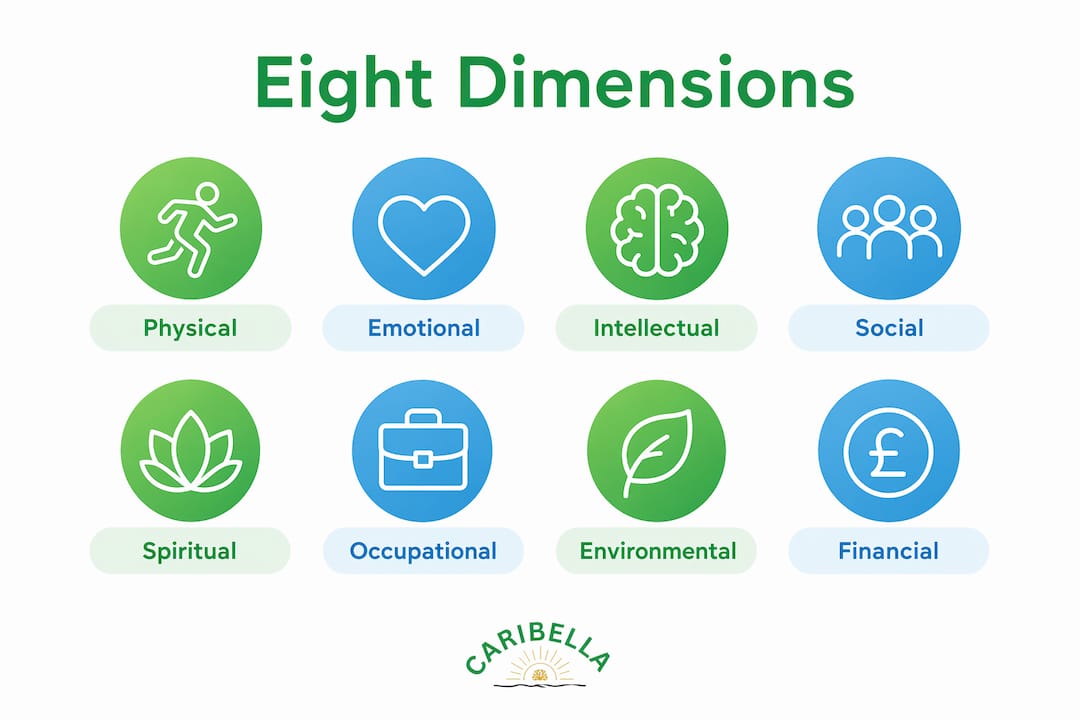
Here is what each dimension actually looks like in daily life:
| Dimension | What it means in practice |
|---|---|
| Emotional | Recognising and managing your feelings; building resilience after stress |
| Environmental | The spaces you live and work in, including air quality, clutter, and access to nature |
| Financial | Feeling secure about money and having enough to meet your needs without chronic anxiety |
| Intellectual | Keeping your mind active through learning, problem-solving, and creative engagement |
| Occupational | Finding meaning and satisfaction in your work or daily purpose, paid or not |
| Physical | Movement, sleep, nutrition, and regular health checks |
| Social | Quality relationships, community connection, and a sense of belonging |
| Spiritual | A sense of meaning, values, or connection to something larger than yourself |
For women over 40, this model is particularly well suited because it acknowledges that health is not just about what you eat or how much you exercise. Your financial stress affects your sleep. Your social connections affect your mental health. Research on wellness dimensions confirms that improving one domain tends to benefit others. A regular walk outdoors, for example, addresses physical, environmental, and even social wellness simultaneously.
The interdependence of these dimensions is what makes a holistic approach so worth understanding. When you learn the definitions of wellness terms across all eight areas, you stop looking for a single fix and start seeing your health as an interconnected system.
Pro Tip: When you feel stuck or low on energy, run a quick mental scan across all eight dimensions. Often the dimension causing the problem is not the obvious one. Financial anxiety frequently shows up as fatigue, and social isolation often presents as poor motivation to exercise.
When wellness language changes
Wellness and medical terminology does not stay still. Terms shift as science advances, and keeping up can feel exhausting. Understanding why terms change, and how to respond when they do, is one of the most practical wellness skills you can develop.
A recent example is the proposed renaming of PCOS (polycystic ovary syndrome) to PMOS (polycystic and metabolic ovary syndrome). The PCOS to PMOS proposal reflects a broader understanding that the condition involves multiple hormone systems and metabolic factors, not just ovarian cysts. For women managing this condition, a name change is not trivial. It signals that treatment approaches may broaden beyond reproductive focus to include metabolic and hormonal monitoring.
The practical lesson here is not to memorise new names as they appear. It is to build a habit of asking: What is this term describing in terms of real physical processes, and what does it mean for how I take care of myself?
“Translating wellness terms into behaviours is more useful than chasing definitions. Ask not what a term is called, but what it is asking you to monitor, change, or prioritise.”
Here is how to develop that translation habit with any evolving term:
- Look for the underlying mechanism. A name change often signals that scientists now understand more about why something happens, not just what it is called.
- Ask what changes practically. Does the new term affect how the condition is diagnosed or treated? If so, that is worth knowing. If it is purely semantic, move on.
- Watch for marketing use. New terminology is frequently adopted by wellness brands before the science has settled. Marketing-led wellness claims can be vague and exploitative. Focus on whether a claim links to measurable outcomes, not just fashionable vocabulary.
- Use reliable sources. NHS guidance, peer-reviewed journals, and established health bodies are your anchors when the wellness space gets noisy.
Putting wellness knowledge to work after 40
Knowing the language is only half the job. The other half is applying it. Here is a practical sequence for making wellness vocabulary work for you as a woman over 40.
-
Learn the terms in your area of concern first. If sleep is your biggest issue right now, get confident with terms like sleep architecture, circadian rhythm, and cortisol. Focused learning is more effective than trying to master everything at once.
-
Validate claims before committing. When a wellness product or programme uses terminology you have learned, ask whether the claim is specific and measurable. Some marketed wellness interventions, including IV vitamin drips and certain detox programmes, lack strong evidence. Knowing what “evidence-based” actually means helps you ask better questions.
-
Align daily habits with wellness dimensions. Use the eight-dimension model as a weekly audit. Which dimensions are you actively supporting? Which are being neglected? This is not about perfection. It is about consistency over time.
-
Build your reference toolkit. Bookmarking one or two trusted sources, such as NHS guidance pages or a practical wellness plan guide, means you have a reliable place to check terms rather than relying on whatever article appeared first in a search.
-
Prioritise social wellness deliberately. Positive social habits build support systems with measurable effects on mental and physical health. This dimension is often the first to be sacrificed to busy schedules, and it tends to be one of the most impactful to restore.
Pro Tip: When evaluating any wellness product or service, try this: replace the wellness buzzword in the claim with “we believe this might.” If the claim still sounds reasonable, it is probably honest. If it sounds weak, that is telling you something important.
My honest take on wellness language
I have spent a long time watching women arrive at wellness conversations visibly overwhelmed. The vocabulary felt like a barrier rather than a tool, and that confusion was stopping them from making any meaningful changes at all.
What I have learned is that you do not need to become fluent in wellness language overnight. You need enough vocabulary to protect yourself from bad advice and to have productive conversations with practitioners, product labels, and your own instincts.
The eight-dimensional model changed how I think about my own health. Before I encountered it, I was treating wellness as a purely physical project: exercise more, eat better, sleep enough. The model made me realise I was neglecting intellectual engagement and, frankly, financial wellness anxiety that was draining my energy more than any dietary gap.
My honest view on wellness buzzwords is this: be suspicious of any term that cannot be connected to a concrete behaviour or measurable outcome. If a brand uses words like “cellular vitality” or “bio-optimised nourishment” without explaining what that means in practical terms, that is a red flag, not a feature. The importance of wellness language lies precisely in its ability to guide action, not just to sound credible.
Start with the definitions that matter most to your life right now. Build from there. The goal is not encyclopaedic knowledge. It is confident, informed choices.
— Nicole
How Caribella supports your wellness journey
Once you understand what different wellness dimensions actually need, choosing products that genuinely support those needs becomes far more straightforward.
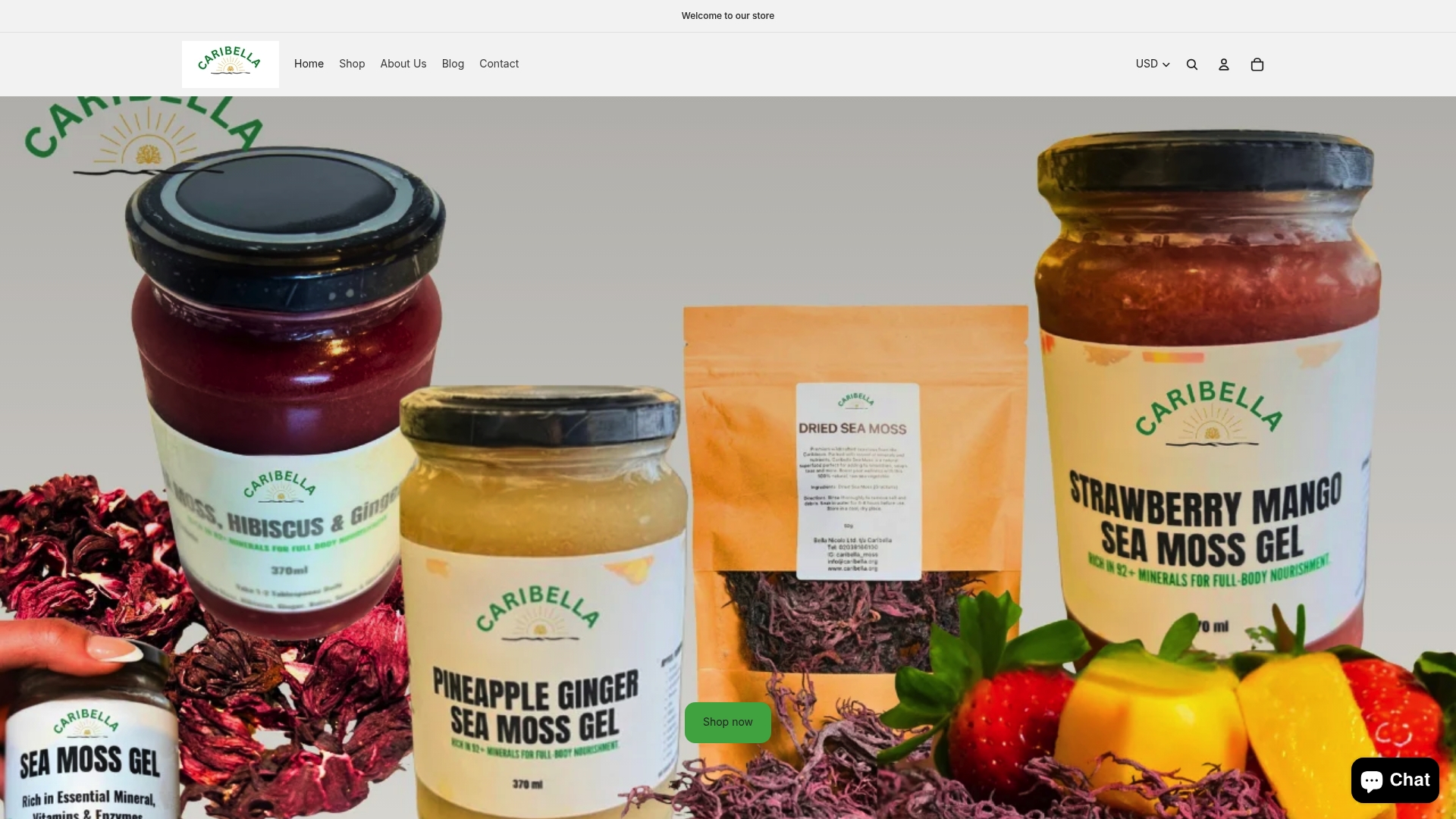
Caribella’s range of sea moss gels and herbal teas is built around the same evidence-backed principle: real ingredients, transparent purposes, and formulations rooted in Caribbean plant traditions that have supported wellbeing for generations. Sea moss, for instance, offers natural support for digestion and energy, two physical wellness dimensions that women over 40 frequently flag as priorities. The herbal teas are crafted to complement multiple dimensions, from stress support to immunity. If you are looking for a thoughtful gift that aligns with a loved one’s wellness goals, Caribella’s wellness gift option brings that intention together in one place.
FAQ
What is the difference between wellness and health?
Health typically refers to your physical and physiological state, while wellness is the active, ongoing pursuit of balance across body, mind, and spirit. Wellness includes health but extends further into emotional, social, and spiritual dimensions.
What are the eight dimensions of wellness?
The eight dimensions are emotional, environmental, financial, intellectual, occupational, physical, social, and spiritual wellness. Improving any one of these dimensions tends to benefit the others, making a holistic approach more effective than focusing on a single area.
Why does wellness terminology keep changing?
Scientific understanding evolves, and terminology updates to reflect new knowledge. The proposed shift from PCOS to PMOS is one example, where a more accurate name better describes the metabolic and hormonal complexity involved. The practical response is to focus on what a term means for your actual care, not just what it is called.
How can I tell if a wellness claim is trustworthy?
Look for specific, measurable outcomes linked to the claim. Be cautious of terms that sound impressive but cannot be connected to a clear physical mechanism or behaviour. Verified sources such as NHS guidance or peer-reviewed research are reliable anchors.
How do I start learning wellness vocabulary without feeling overwhelmed?
Start with the dimensions or health areas most relevant to your life right now. Build your vocabulary in focused areas rather than all at once. Trusted resources, including herbal wellness guides for women over 40, offer grounded starting points without the jargon overload.